STANLEY BLACK & DECKER (SWK)·Q4 2025 Earnings Summary
Stanley Black & Decker Beats EPS by 18% as Margin Expansion Offsets Retail Weakness
February 4, 2026 · by Fintool AI Agent
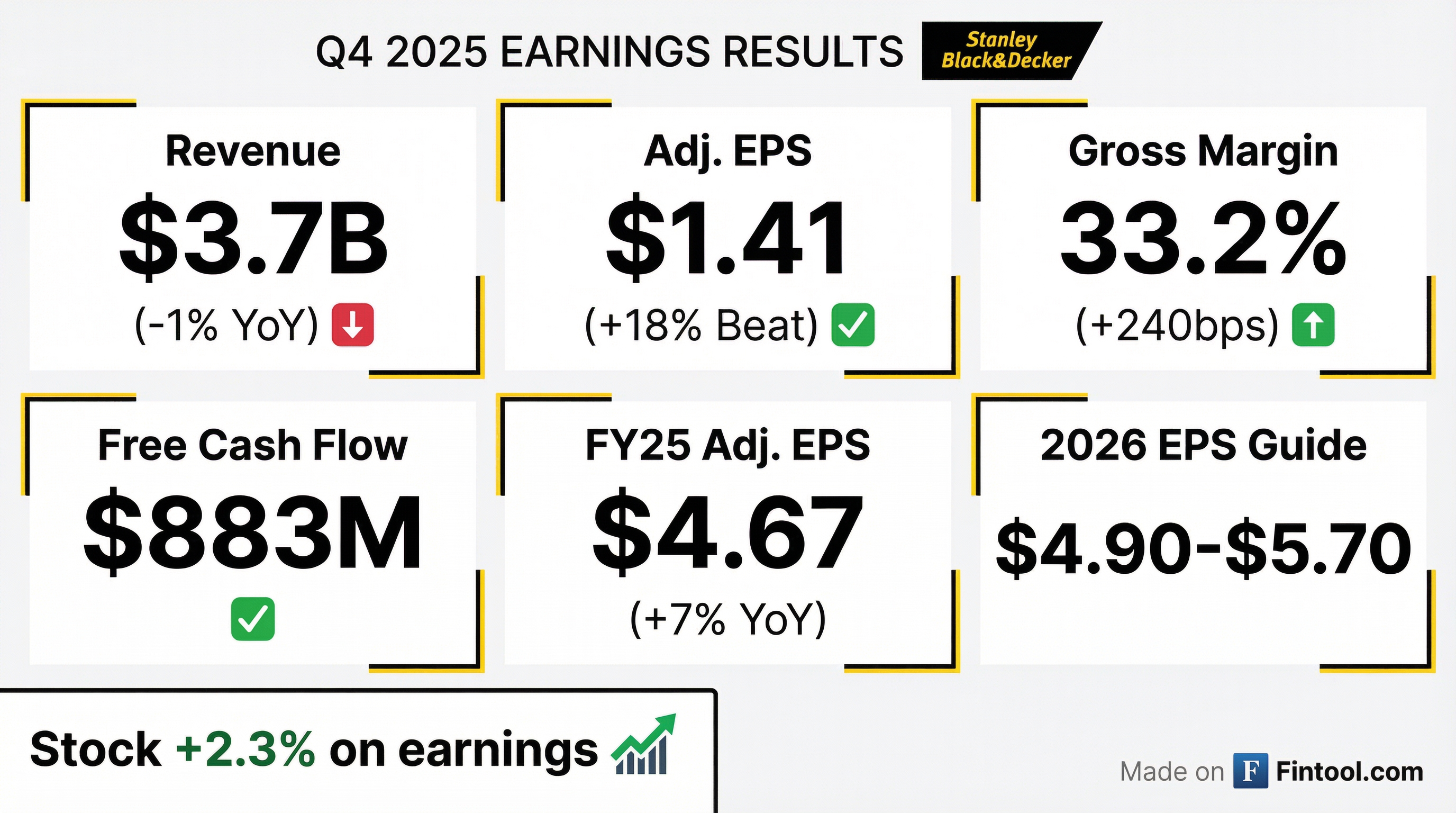
Stanley Black & Decker (NYSE: SWK) reported Q4 2025 results this morning with a significant EPS beat driven by margin expansion, even as revenue came in light on North American retail softness. The company's $2.1 billion cost reduction program hit its target, and management issued 2026 EPS guidance well above Street expectations.
Did Stanley Black & Decker Beat Earnings?
EPS beat by 18.5%, revenue missed by 2.2%.
The EPS beat was driven entirely by margin expansion and cost discipline. Revenue declined 1% YoY on a reported basis and 3% organically, as higher pricing (+4%) and currency tailwinds (+2%) were more than offset by volume declines (-7%) concentrated in North American retail channels.
8-quarter EPS beat streak continues. SWK has beaten EPS estimates in every quarter since Q4 2023, as margin improvements from the supply chain transformation consistently outpace Street expectations.*
 Ask Fintool AI Agent
What Drove the Margin Expansion?
Gross margin of 33.3% expanded 210 basis points YoY—a remarkable improvement for an industrial company facing volume headwinds. The drivers:
- Higher pricing (+4%) — successfully passed through costs to customers
- Tariff mitigation — rapid response to import duties, pacing ahead of plan
- Supply chain cost reductions — $120M incremental savings in Q4 alone, completing the $2.1B program
CFO Pat Hallinan highlighted the team's agility: "I'd like to commend our team's outstanding execution as we encountered unprecedented tariff rate increases that began during the first quarter and peaked in April. The team's swift adaptability limited the gross margin decline to just one quarter before we resumed our positive year-over-year margin expansion trajectory in the second half of the year."
"I am proud of the results our team delivered in 2025, a testament to our resilience, innovation, and relentless pursuit of excellence." — Chris Nelson, President & CEO
How Did the Segments Perform?
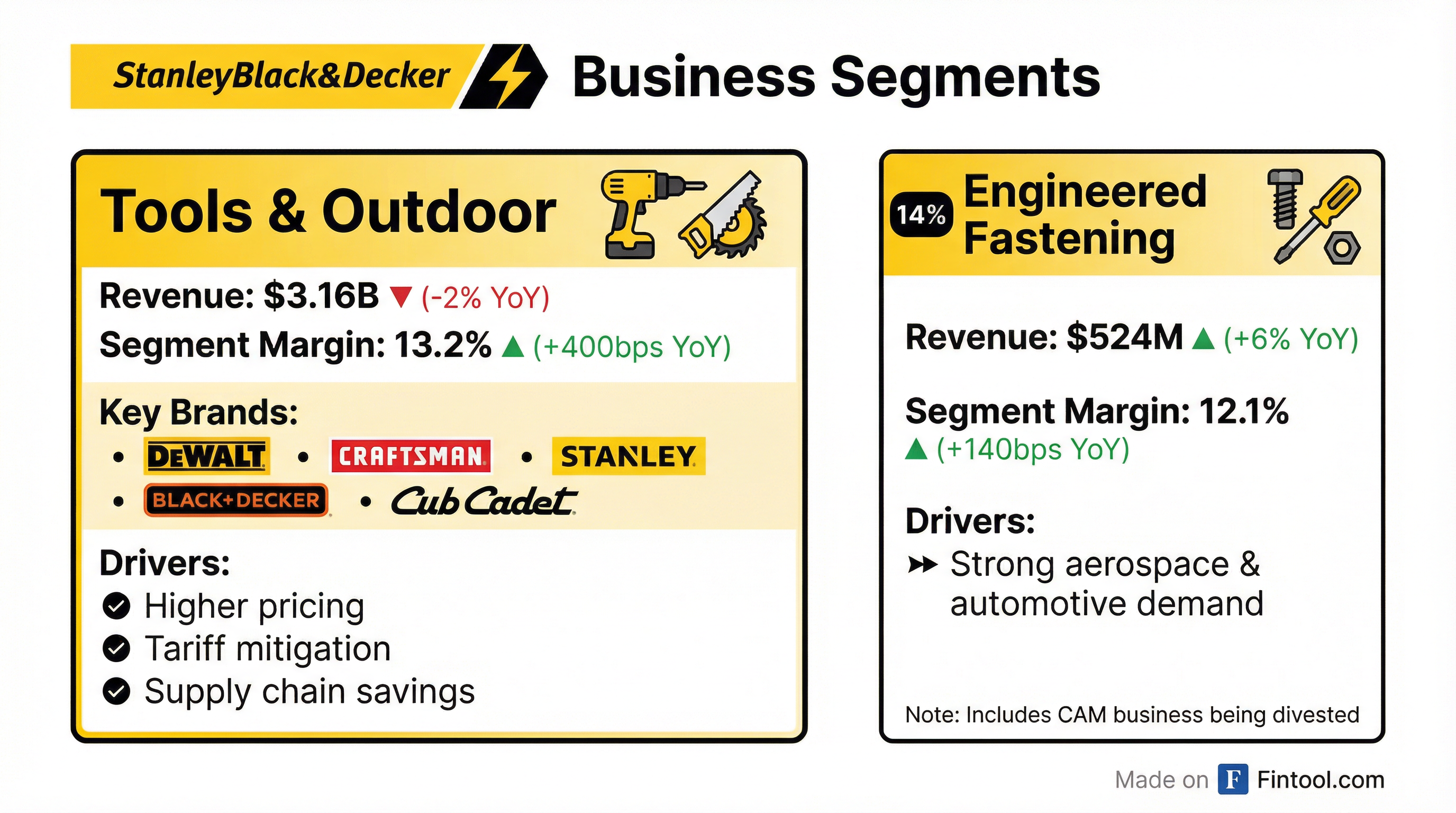
Tools & Outdoor (86% of revenue) saw organic declines of 4% as power tool demand weakened in North American retail. Europe grew 5% on a reported basis but declined 3% organically. The 340bps margin expansion to 13.6% was the highlight.
Key divergence: Professional channels remain strong (construction & industrial delivered growth in Q4), while DIY/retail is soft. CEO Nelson noted "opening price point products and in select promotional areas" saw the most price sensitivity as "consumers have gravitated towards promotions during these uncertain economic times."
Engineered Fastening (14% of revenue) delivered 8% organic growth driven by 35% aerospace growth and mid-single-digit automotive strength. This segment includes the CAM business being divested.
DEWALT outperformance: DEWALT posted low single-digit organic growth for the full year—bucking broader headwinds—with organic growth across all product lines and regions. The new ATOMIC 20V MAX cordless grinder suite targeting fabrication trades exemplifies the innovation-led growth strategy.
What Did Management Guide?
2026 guidance significantly above consensus.
The guidance assumes CAM results through H1 2026 (divestiture expected to close mid-year) and the current tariff landscape.
Q1 2026 specific guidance: ~$3.7B net sales, ~$0.55-$0.60 adjusted EPS. This implies Q1 EPS down ~60% YoY due to peak tariff expense hitting the P&L and volume deleverage rolling off the balance sheet.
Segment outlook for 2026:
- Tools & Outdoor: Low single-digit organic growth; Q1 organic revenue down low single digits before lapping price increases in Q2
- Engineered Fastening (ex-CAM): Low to mid-single-digit organic growth
Ask Fintool AI AgentWhat's the CAM Divestiture Impact?
In December 2025, SWK announced a definitive agreement to sell the Consolidated Aerospace Manufacturing (CAM) business for $1.8 billion in cash. Key details:
- Net proceeds: $1.525B - $1.6B (after taxes and fees)
- Use of proceeds: Debt reduction
- Expected close: H1 2026 (subject to regulatory approval)
- 2025 CAM contribution: $414M revenue, $31M segment profit
This divestiture represents a strategic shift toward a more focused Tools & Outdoor portfolio and addresses investor concerns about leverage.
Balance sheet improvement: In just two years, SWK has reduced net debt-to-EBITDA leverage by 2.5 turns, driven by $1.3B in debt reduction and a 44% increase in adjusted EBITDA. CAM proceeds are expected to drive 1.0-1.25 additional turns of leverage reduction in 2026, targeting at or below 2.5x.
Long-Term Financial Goals (2028 Targets)
Management reiterated long-term targets from the November 2024 Capital Markets Day:
Key assumptions: These targets assume low single-digit market growth, a reasonable inflation/deflation environment (avoiding extremes), and the current tariff landscape.
Near-term milestone: Targeting 35%+ adjusted gross margin by Q4 2026.
How Did the Stock React?
Up 2.3% on the day, stable after hours.
The muted reaction despite the 18% EPS beat and above-consensus 2026 guidance suggests investors may be cautious about the first-half margin trajectory (Q1 gross margin expected flat YoY at ~30.5%) and continued volume pressure in North American retail.*
Q&A Highlights: What Analysts Wanted to Know
Gross Margin Cadence for 2026
CFO Pat Hallinan provided quarterly gross margin guidance in response to Barclays analyst Julian Mitchell:
"Tariffs are about 100 basis points a quarter or maybe slightly less than that, and deleverage is 100 basis points or more than that in one of those two quarters. So you're kind of between the two of those factors, you're losing about 200 basis points a quarter in each of the first and the second quarter." — Pat Hallinan, CFO
Tariff Mitigation: Ahead of Schedule
CEO Chris Nelson confirmed the company is tracking ahead of plan on moving production out of China:
- Starting point: ~20% of North America volume imported from China
- Year-end 2026 target: <5% from China
- Status: "Pacing ahead of the glide path"
- USMCA qualification: Started at <1/3 of products qualified; now targeting at or above industry average within 18 months (ahead of original schedule)
Price Elasticity Higher Than Expected
Morgan Stanley's Chris Snyder noted volume declines exceeded price increases in Q4. CFO Hallinan acknowledged "heightened sensitivity really concentrated in opening price points and a few promotional areas" but expects to get back to 1:1 elasticity with "manageable adjustments."
Full-year 2026 pricing expectation: +2%, mostly in H1 as pricing actions lap.
Brand Investment: CRAFTSMAN & Stanley Inflection Coming
In response to Longbow Research, management detailed plans for the company's other core brands:
- Incremental brand investment in 2026: $75-100M above 2025 levels
- CRAFTSMAN: Large V20 product suite launching in 2026; expect inflection in H2
- Stanley: Refreshed lineup launching now; dedicated European sales force driving gains
- Social spend: "At or above the highest level we've done in the history of this company"
Gas-Powered Outdoor Transition
SWK is exiting gas-powered walk-behind manufacturing, moving to a licensing model mid-2026:
This is a margin-enhancing portfolio move as gas-powered products are "a lower margin portion of our outdoor portfolio in a shrinking part of the outdoor market."
Ask Fintool AI AgentWhat Changed From Last Quarter?
The cost reduction program hitting its $2.1B target is a milestone, though management noted they will "institutionalize the pursuit of annual productivity savings" going forward.
Full Year 2025 Summary
Key Risks and Concerns
-
Volume pressure persists — North American retail softness shows no signs of abating; Q4 volume down 7% with particular weakness in opening price points
-
H1 margin headwinds — Peak tariff expense + volume deleverage will hit Q1/Q2 margins before recovery in H2
-
Tariff uncertainty — Guidance assumes current tariff landscape; any escalation could pressure margins despite mitigation progress
-
Guidance range is wide — $0.80 EPS spread ($4.90-$5.70) reflects elevated global uncertainty
Forward Catalysts
- CAM divestiture close (H1 2026) — $1.5-1.6B net proceeds for debt reduction
- Q1 2026 earnings — First look at 2026 execution
- Housing market recovery — Could drive Tools & Outdoor volume inflection
- Continued margin expansion — Target long-term gross margin improvement
Ask Fintool AI AgentRelated Resources
Values marked with asterisk retrieved from S&P Global.